Category Emerging ideas

Emerging ideas

Caring for the Whole Student: Well-being as a Foundation for Learning

Colorful illustration of the framework for belonging from Design for Belonging: How to Build Inclusion and Collaboration in Your Communities, illustrated by Rose Jaffe. Different scenes have people interacting in a timeline: The invitation, Entering, Participating, Code Switching, Contributing, Flowing, Dissenting, Repairing, Diverging & Exiting.

"Human learning is socially constructed: we come to understand the world through our interactions with others. Feeling part of a community of learners is a powerful motivator," writes national expert on academic mindsets Camille Farrington. This Teaching Tip explores how fostering student well-being enhances learning and engagement. When students feel connected, supported, and valued, they are more likely to participate actively, take intellectual risks, and persist through challenges.

Introducing ArcticVū: UAF’s Virtual Production Studio

A still shot from Media Day with the UAF Girls Volleyball team in the ArcticVū studio.

At UAF’s Center for Teaching and Learning, we see video not just as a technical tool but as a way to transform teaching and research. Our newest resource, the ArcticVū virtual production studio, uses LED wall technology to place faculty, students, and guests into realistic, dynamic environments—from Arctic field sites to immersive classrooms. Built to expand access and spark creativity, ArcticVū makes cinematic-quality media production available to the entire UAF community.

In Case of Emergency, Hope

A detail from a mixed media painting by Madara Mason of a standing polar bear holding a heart and flame in its upright left fore paw.

When faced with uncertainty, prioritizing hope can serve as a guiding force for both instructors and students in higher education. Pursuing hope allows educators to connect to their values and maintain a transformative vision, fostering deeper relationships with students and strengthening the academic community. By engaging in reflective practices, collaboration, and creative thinking, we can create meaningful, hopeful futures.

Transformative Learning in Your Class

Climbers at the top of an outcropping, overlooking a boreal forest.

In the summer of 2012 the University of Alaska Board of Regents approved revisions to Policy 01.01.030 — University of Alaska Fairbanks Mission Statement and University of Alaska Fairbanks Core Themes. Contained therein was this vision statement: "Excellence through transformative experiences." How can we aspire to such a lofty goal? What is the intersection with teaching and learning? And, how might you go about fostering such things in your courses?

From Campus to Career: Adapting Higher Education to Modern Hiring Trends

Illustrated people moving multi-color puzzle pieces around a stylized environment.

In recent years, hiring practices have undergone significant transformations, accelerated by the impact of COVID-19. In response, higher education institutions are re-evaluating their roles in preparing students for the evolving job market. Microcredentials have emerged as a valuable tool to bridge the gap between academic learning and practical job skills. These credentials provide a verifiable way for students to showcase their competencies and align with employer demands for problem-solving, communication, and teamwork skills. Despite the shift away from traditional degree requirements, a college degree combined with relevant microcredentials is increasingly preferred by employers. This article explores how higher education can adapt to these changes by integrating microcredentials into their programs, enhancing students' employability, and aligning educational outcomes with market needs.

Q&A on AI Text Detection

A student working on a laptop in a cabin while a humanoid robot leans over his shoulder.

Are there any tools that can reliably detect if writing was created with artificial intelligence? No. No, There are no tools which can reliably detect AI-generated writing. This teaching tip covers the current state of automatic AI detection and where it falls short of being reliable, and illustrates why this trend will continue. More importantly, this teaching tip presents some methods in which faculty content experts can determine if writing has been created with AI.

Sharpening Critical Thought with ChatGPT

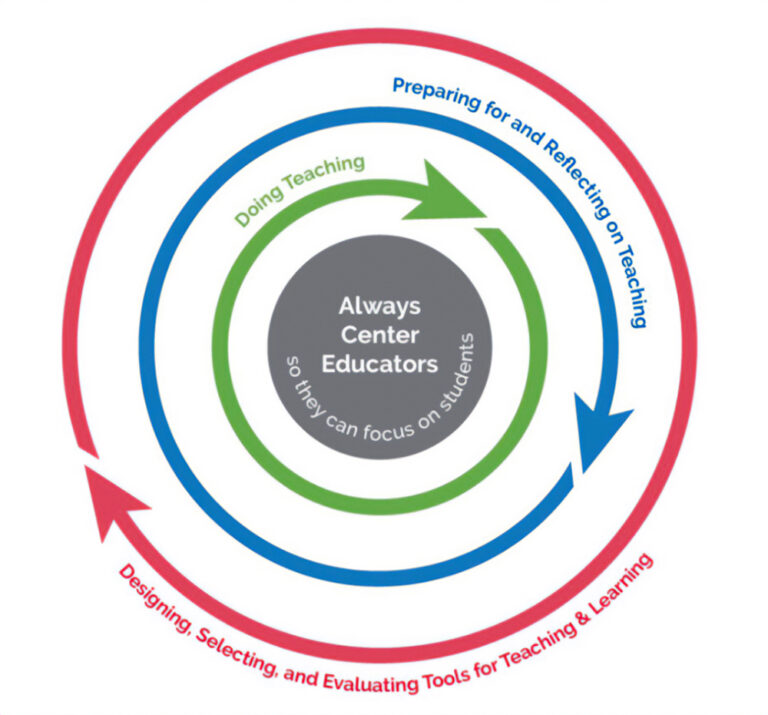
A diagram of concentric circles that place educators at the center of teaching design, preparation and practice

In this teaching tip, we explore the possibility of using ChatGPT to develop rich question pools with correct and incorrect responses and having students examine each response in a low-stakes manner. The teaching practice is borrowed from a published article from the Journal of Chemical Education.