CTL is currently undergoing changes, and some tools on this page are under maintenance. We appreciate your patience during this transition. If you need immediate support, please submit a consult request here.

Introducing ArcticVū: UAF’s Virtual Production Studio

From VHS to Virtual Production
When I was an undergraduate student at UAF in the mid-2000s, I managed the on-campus TV station, KSUA-TV. Our automation system consisted of three VHS decks automated by infrared controllers. Wanting to expand opportunities for students, I petitioned for access to the on-campus television studio. I sent emails, met with administrators, and was denied. That experience impressed on me the importance of access. A facility has little value if people can’t use it.
Today, I oversee that studio in my role at the Center for Teaching and Learning. Our culture of collaboration and saying “yes” means that my job is opening doors, not guarding them. That’s why we built ArcticVū, UAF’s new virtual production studio—to support teaching, research, and storytelling with tools that make ideas tangible.
Takeaways
- ArcticVū brings immersive LED wall virtual production to UAF for teaching, research, and storytelling.
- CTL provides support to make this high-end technology approachable and usable for faculty, staff, and students.
- Virtual production is becoming a standard in higher education
- The studio is available now—schedule time at the CTL Media Studio page
What ArcticVū Brings
The ArcticVū Studio features a piece of remarkable technology: A Vū One Mini. It is an all-in-one LED-based virtual production system that combines a high-resolution, 12’x7’ LED wall, camera tracking, and dynamic lighting. Unlike green screens, which require a leap of imagination during shooting and heavy editing afterward, the Vū One Mini places people directly into photorealistic environments in real time—an Arctic field site, a Nanook tradition event, or even the inside of a living cell—complete with realistic reflections and lighting. From classrooms to creative productions, it allows faculty, students, and researchers to interact with digital backdrops that look and feel real. And because the illusion works in-camera, the resulting file is publication-ready.
Faculty can record immersive lectures, simulate fieldwork, or create realistic training scenarios. Students can design research demonstrations, livestream performances, produce esports events, or create artistic projects like music videos. The studio is also a resource for alumni stories, virtual events, and community engagement. The result is a flexible, research-informed tool that’s open to the entire UAF community.
National Momentum
Across the country, universities are investing in virtual production as part of their teaching and learning infrastructure. The University of South Florida now produces three times the media for students because virtual production bypasses travel and weather challenges. Faculty describe their studio as a “game changer” for pushing creativity and bringing any story to life. The University of Toledo quickly found uses in athletics, recruitment, and student media. Prospective athletes noted, “My last school didn’t have anything like this” (Toledo Case Study, 2025). Texas A&M University is building the first-of-its-kind Virtual Production Institute designed for interdisciplinary applications—from performance and visualization to healthcare and aerospace.
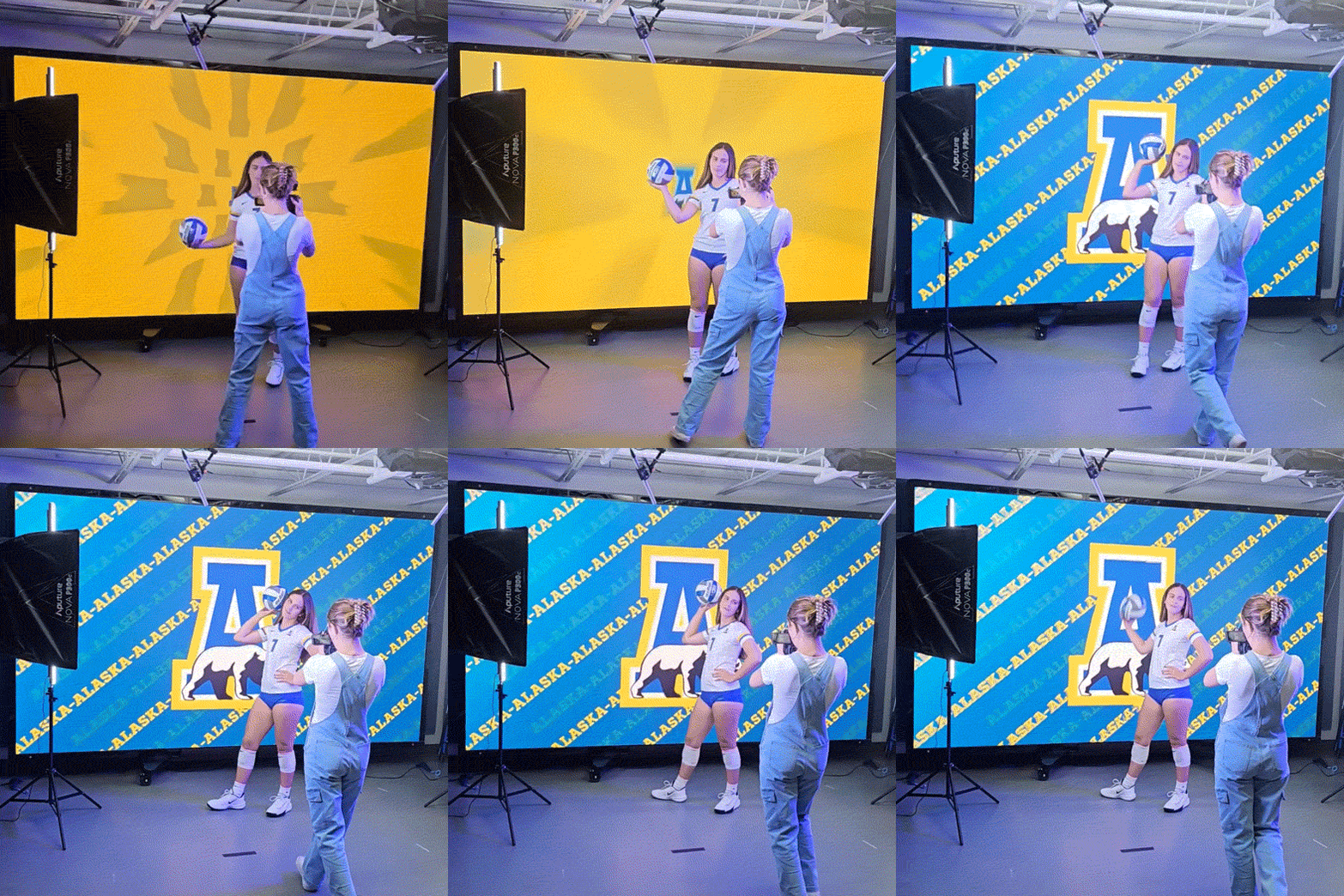
Here in the North, The ArcticVū Studio is facilitating great productions already. Nanook Volleyball filmed their season opener promo with ArcticVū—an early example of how the studio elevates UAF storytelling while keeping production right here on campus and actually saving staff time thanks to an enhanced workflow.
These examples show that virtual production isn’t a luxury. It’s becoming an emerging standard for modern universities, preparing learners for industries and technologies that don’t yet exist.
Innovation Grounded in Practice
At UAF, CTL has long served as both steward and innovator for media resources. In 2016, Owen Guthrie and I ordered and installed our first lightboard, transforming how video lectures were created. That move reflected a growing research base: students expect high-quality courses to include video and value when an instructor’s presence and personality come through (Hibbert, 2014). They also attend more closely to concepts when instruction is presented partly with video instead of text alone, finding it both easier to follow and more motivating (Choi & Johnson, 2005).
At the same time, research reminds us that production value on its own does not necessarily improve outcomes—what matters most is the pedagogical intent (Hansch et al., 2015). Designing learning activities around video viewing has also been shown to enhance student success (Vural, 2013).
ArcticVū builds on that foundation. Just as lightboards enabled faculty to produce effective short lectures, the Vū One Mini enables immersive scenarios that align with what we know about presence, memory, and engagement (Choi & Johnson, 2005; Hibbert, 2014).
Like our other services, we intend for ArcticVū to serve as a space for experimentation and institutional growth while ensuring innovations stay aligned with teaching and learning priorities. CTL is pleased to offer this platform for faculty creativity, interdisciplinary collaboration, and student engagement that’s both high-tech and high-impact.
Invitation
The ArcticVū Studio is not just for athletics, film, or communications—it’s for you. We want to see it used in biology courses, in anthropology storytelling, in fisheries simulations, in history projects, in student showcases. We want to co-create, prototype, and dream with you.
Book the space, try it out, and help us push what’s possible at UAF. Visit the CTL Media Studio page to learn more and schedule a session.
References
Bowles-Terry, M., Hensley, M. K., & Hinchliffe, L. J. (2010). Best practices for online video tutorials in academic libraries: A study of student preferences and understanding. Communications in Information Literacy, 4(1), 17–28.
Choi, H. J., & Johnson, S. D. (2005). The effect of context-based video instruction on learning and motivation in online courses. The American Journal of Distance Education, 19(4), 215–227.
Geri, N., Winer, A., & Zaks, B. (2017). Challenging the six-minute myth of online video lectures: Can interactivity expand the attention span of learners? Online Journal of Applied Knowledge Management, 5(1), 101–111.
Guo, P. J., Kim, J., & Rubin, R. (2014). How video production affects student engagement: An empirical study of MOOC videos. Proceedings of the First ACM Conference on Learning at Scale.
Hansch, A., Hillers, L., McConachie, K., Newman, C., Schildhauer, T., & Schmidt, P. (2015). Video and online learning: Critical reflections and findings from the field.
Hibbert, M. C. (2014). What makes an online instructional video compelling? Educause Review Online.
den Hamer, A. (2025). Beyond essays: engaging students through media assignments. Media & Learning Association.